



Insights: Dealing with Latrophobia
Iatrophobia is derived from the Greek word ‘Iatros’ which means healing. Many a time the thought of visiting doctor results in anxiety and distress in some individuals. No matter how much they suffer, patients tend to avoid visiting a doctor. Such situations lead to delay in consulting a physician, lack or delay in treatment, thereby leading to worsening of patient condition.
An in-app survey was conducted on WhiteCoats to determine the doctor’s perception of different factors causing iatrophobia in patients.
The survey comprised of 5 different questions and doctors from various specialties actively responded to the survey.
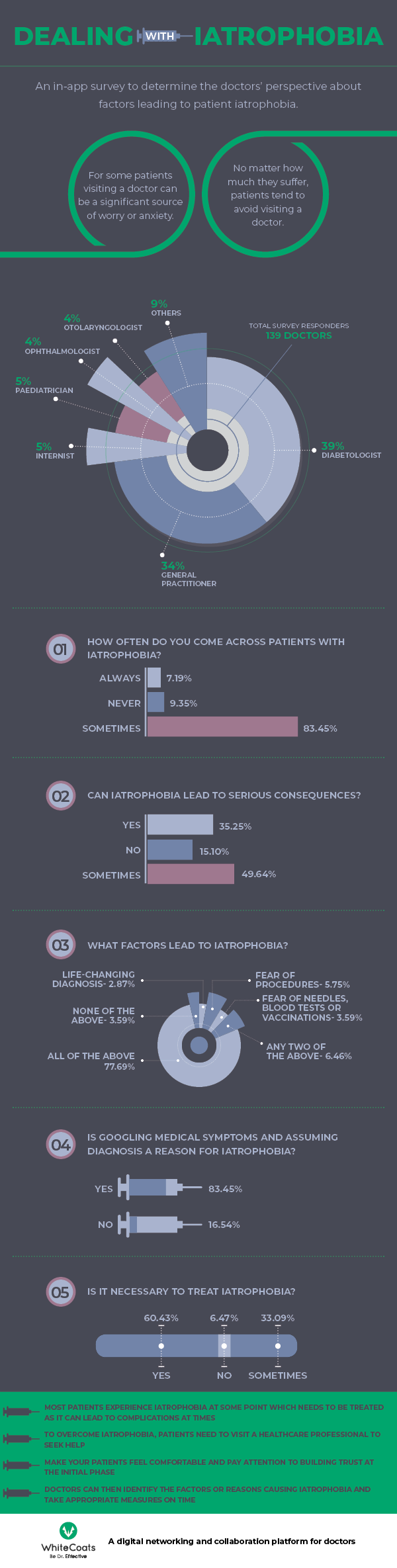
A total of 139 doctors responded to our survey, which consisted of diabetologists (39%), general practitioners (34%), internists (5%), paediatricians (5%), ophthalmologists (4%), otolaryngologists (4%), and others (9%).
83.45% of doctors agreed that their patients experience iatrophobia sometimes, while 7.19% mentioned they came across iatrophobia patients always.
When asked if iatrophobia conditions can lead to serious complications a majority of physicians said sometimes (49.64%) or always (35.25%).
77.69% of doctors agreed that life-changing diagnosis, fear of procedures, and fear of needles, blood tests/vaccinations were the reasons for the development of iatrophobia in individuals.
83.45% of doctors think that googling their medical symptoms and concluding on a diagnosis of their own and the fear that it would be right, was one of the reasons for iatrophobia.
Almost 60.43% of physicians think that iatrophobia should be treated while 33.09% of physicians stated that the condition should be managed sometimes.
Coping and overcoming iatrophobia is often tough since most individuals refuse to consult a doctor.
Searching for symptoms and assuming to have a condition is easily possible with the help of advanced technology. But often these may not be true and it is essential to visit a doctor to confirm the right diagnosis.
Understanding a patient’s fear or anxiety, making them feel comfortable, and paying attention to building trust could be the initial steps that could be taken before a personalized therapy for iatrophobia.
To know more about how WhiteCoats can help you in your professional advancement, visit www.whitecoats.com
